Phone: (+33) 625 16 20 71 - Sunday to Friday
contact@alliancemedicalfrance.fr
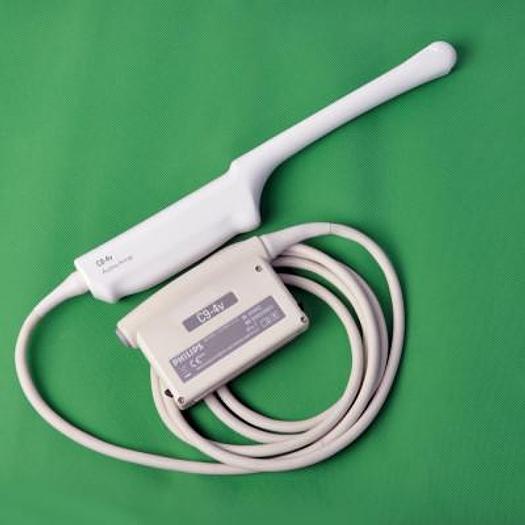
Philips C9-4V endovaginal probe with 9–4 MHz bandwidth, 128 elements and 181° field of view. Designed for gynecology, fertility, obstetrics and urology imaging.
The Philips C9-4V is an endocavitary ultrasound probe with a tightly curved array, designed primarily for endovaginal examinations and gynecological, obstetric, fertility, and urological applications. Its broadband technology and 9–4 MHz frequency range allow imaging to be adapted to different examination depths.
The C9-4V is specifically designed for endocavitary examinations, with a geometry adapted to pelvic imaging. Its wide 181° field of view provides extensive visualization of pelvic anatomy from an endocavitary position.
The probe is suitable for ultrasound evaluation of gynecological and obstetric structures. Philips lists it for gynecology, obstetrics, and fertility applications, supporting imaging of pelvic structures and related ultrasound examinations.
With its endocavitary design and 9–4 MHz frequency range, the C9-4V can be used for fertility and reproductive medicine examinations, including ultrasound assessment of pelvic structures.
Philips also specifies the C9-4V for selected urological applications. Its endocavitary design provides close access to anatomical structures requiring examination.
The C9-4V's broadband technology provides an operating frequency range of 9–4 MHz. Higher frequencies support detailed imaging of relatively superficial structures, while lower frequencies provide greater penetration for deeper anatomy.
With a 181° field of view, the C9-4V is designed to provide extensive coverage during endocavitary examinations. This is particularly useful for imaging pelvic and gynecological anatomy.
The Philips C9-4V is biopsy capable according to Philips specifications. It can therefore be used for compatible ultrasound-guided interventional applications with the appropriate system and accessories.
Philips specifies that the C9-4V is not compatible with Image Fusion Navigation. This should be distinguished from advanced imaging functions available on certain Philips ultrasound systems.
The C9-4V's tightly curved array is optimized for endocavitary applications. Its design and wide field of view are suited to endovaginal examinations requiring extensive visualization of the pelvic anatomy.
The Philips C9-4V is an endocavitary ultrasound probe with a tightly curved array, designed primarily for endovaginal examinations and gynecological, obstetric, fertility, and urological applications. Its broadband technology and 9–4 MHz frequency range allow imaging to be adapted to different examination depths.
The C9-4V is specifically designed for endocavitary examinations, with a geometry adapted to pelvic imaging. Its wide 181° field of view provides extensive visualization of pelvic anatomy from an endocavitary position.
The probe is suitable for ultrasound evaluation of gynecological and obstetric structures. Philips lists it for gynecology, obstetrics, and fertility applications, supporting imaging of pelvic structures and related ultrasound examinations.
With its endocavitary design and 9–4 MHz frequency range, the C9-4V can be used for fertility and reproductive medicine examinations, including ultrasound assessment of pelvic structures.
Philips also specifies the C9-4V for selected urological applications. Its endocavitary design provides close access to anatomical structures requiring examination.
The C9-4V's broadband technology provides an operating frequency range of 9–4 MHz. Higher frequencies support detailed imaging of relatively superficial structures, while lower frequencies provide greater penetration for deeper anatomy.
With a 181° field of view, the C9-4V is designed to provide extensive coverage during endocavitary examinations. This is particularly useful for imaging pelvic and gynecological anatomy.
The Philips C9-4V is biopsy capable according to Philips specifications. It can therefore be used for compatible ultrasound-guided interventional applications with the appropriate system and accessories.
Philips specifies that the C9-4V is not compatible with Image Fusion Navigation. This should be distinguished from advanced imaging functions available on certain Philips ultrasound systems.
The C9-4V's tightly curved array is optimized for endocavitary applications. Its design and wide field of view are suited to endovaginal examinations requiring extensive visualization of the pelvic anatomy.
 Francais