Phone: (+33) 625 16 20 71 - Sunday to Friday
contact@alliancemedicalfrance.fr
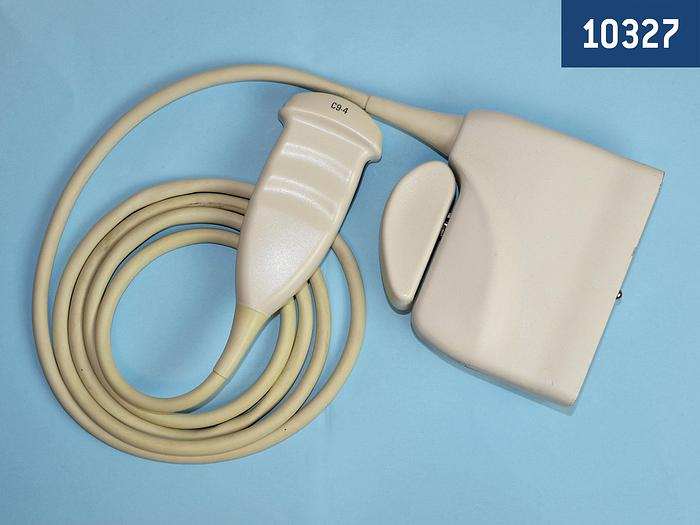
Philips C9-4v broadband curved probe with a 9–4 MHz range and 128 elements. Designed for endocavitary imaging in obstetrics, gynecology, fertility and urology.
The Philips C9-4 is a broadband curved-array ultrasound transducer designed for diagnostic imaging applications requiring a combination of penetration and anatomical coverage. Its convex configuration is suitable for examinations of deeper anatomical structures, while its broadband frequency range provides flexibility for different clinical imaging requirements.
The C9-4 uses a curved-array configuration with a broadband frequency range of 9–4 MHz. This frequency range allows the transducer to be used for both relatively superficial and deeper examinations, with lower frequencies supporting penetration and higher frequencies supporting greater detail when imaging conditions permit.
The curved geometry of the Philips C9-4 is designed to provide a broad acoustic window for imaging deeper anatomical structures. Its broadband operation makes it suitable for a range of diagnostic ultrasound examinations where both penetration and image detail are required.
The 9–4 MHz broadband range provides flexibility in selecting an appropriate operating frequency according to the patient's anatomy and examination depth. Lower-frequency operation can support deeper penetration, while higher-frequency operation can provide increased detail for structures within the effective imaging range.
The 65° field of view provides a broad sector of anatomical coverage from the curved footprint, making the transducer suitable for examinations where a wide scanning window is beneficial.
The curved-array configuration of the C9-4 produces a divergent imaging field that is particularly useful for examining deeper structures. The convex footprint facilitates access to anatomical regions where a wider field of view and greater penetration are required.
With its broadband operation and curved-array design, the C9-4 provides a versatile solution for general diagnostic ultrasound. Its configuration makes it particularly appropriate for applications requiring deeper tissue penetration and broad anatomical visualization.
The Philips C9-4 is a broadband convex ultrasound transducer featuring a curved-array configuration, 192 elements, a 9–4 MHz frequency range and a 65° field of view. Its design provides a combination of penetration, anatomical coverage and imaging flexibility for general diagnostic, abdominal and obstetric ultrasound examinations.
The Philips C9-4 is a broadband curved-array ultrasound transducer designed for diagnostic imaging applications requiring a combination of penetration and anatomical coverage. Its convex configuration is suitable for examinations of deeper anatomical structures, while its broadband frequency range provides flexibility for different clinical imaging requirements.
The C9-4 uses a curved-array configuration with a broadband frequency range of 9–4 MHz. This frequency range allows the transducer to be used for both relatively superficial and deeper examinations, with lower frequencies supporting penetration and higher frequencies supporting greater detail when imaging conditions permit.
The curved geometry of the Philips C9-4 is designed to provide a broad acoustic window for imaging deeper anatomical structures. Its broadband operation makes it suitable for a range of diagnostic ultrasound examinations where both penetration and image detail are required.
The 9–4 MHz broadband range provides flexibility in selecting an appropriate operating frequency according to the patient's anatomy and examination depth. Lower-frequency operation can support deeper penetration, while higher-frequency operation can provide increased detail for structures within the effective imaging range.
The 65° field of view provides a broad sector of anatomical coverage from the curved footprint, making the transducer suitable for examinations where a wide scanning window is beneficial.
The curved-array configuration of the C9-4 produces a divergent imaging field that is particularly useful for examining deeper structures. The convex footprint facilitates access to anatomical regions where a wider field of view and greater penetration are required.
With its broadband operation and curved-array design, the C9-4 provides a versatile solution for general diagnostic ultrasound. Its configuration makes it particularly appropriate for applications requiring deeper tissue penetration and broad anatomical visualization.
The Philips C9-4 is a broadband convex ultrasound transducer featuring a curved-array configuration, 192 elements, a 9–4 MHz frequency range and a 65° field of view. Its design provides a combination of penetration, anatomical coverage and imaging flexibility for general diagnostic, abdominal and obstetric ultrasound examinations.
 Francais