Phone: (+33) 625 16 20 71 - Sunday to Friday
contact@alliancemedicalfrance.fr
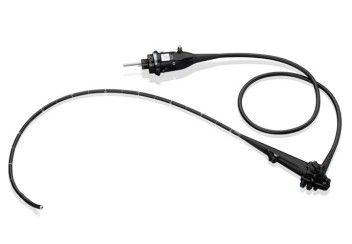
Olympus GIF-1TH190 is a therapeutic EVIS EXERA III gastroscope with HDTV imaging and NBI. It has a 3.7mm channel, 10.0mm distal end, close focus at 2mm, and a forward water jet. Pairs with CV-190 and CLV-190.
The GIF-1TH190 is a therapeutic gastroscope from Olympus's EVIS EXERA III line, built around HDTV imaging and a wide 3.7mm instrument channel for treatment work in the upper digestive tract.
The scope delivers high-definition observation, even with the slimmer scope design Olympus used for this generation.
NBI on the GIF-1TH190 gives twice the viewable distance of the earlier EVIS EXERA II 180 series scopes (specifically the GIF Type Q180) and is significantly brighter. HD NBI adds contrast that can help read mucosal morphology, vascular patterns, and blood vessel appearance — including in patients with Barrett's esophagus.
The scope allows close observation of the mucosal surface down to 2mm, without needing electronic magnification.
A forward water jet keeps the mucosa clear during both observation and treatment.
The redesigned connector is fully submersible, cutting setup effort and removing the need for a water-resistant cap — and with it, the risk of an expensive repair from accidental immersion.
At 10.0mm, the distal end is 0.9mm smaller than its predecessor (the GIF Type 1TQ160), while still keeping the 3.7mm instrument channel needed for therapeutic accessories.
The GIF-1TH190 is a therapeutic gastroscope from Olympus's EVIS EXERA III line, built around HDTV imaging and a wide 3.7mm instrument channel for treatment work in the upper digestive tract.
The scope delivers high-definition observation, even with the slimmer scope design Olympus used for this generation.
NBI on the GIF-1TH190 gives twice the viewable distance of the earlier EVIS EXERA II 180 series scopes (specifically the GIF Type Q180) and is significantly brighter. HD NBI adds contrast that can help read mucosal morphology, vascular patterns, and blood vessel appearance — including in patients with Barrett's esophagus.
The scope allows close observation of the mucosal surface down to 2mm, without needing electronic magnification.
A forward water jet keeps the mucosa clear during both observation and treatment.
The redesigned connector is fully submersible, cutting setup effort and removing the need for a water-resistant cap — and with it, the risk of an expensive repair from accidental immersion.
At 10.0mm, the distal end is 0.9mm smaller than its predecessor (the GIF Type 1TQ160), while still keeping the 3.7mm instrument channel needed for therapeutic accessories.
 Francais