Phone: (+33) 625 16 20 71 - Sunday to Friday
contact@alliancemedicalfrance.fr
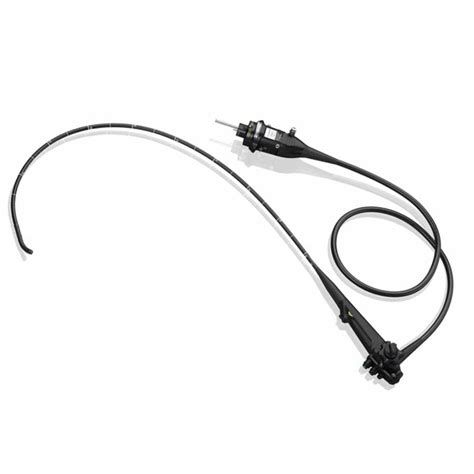
Olympus GIF-H190 is an EVIS EXERA III gastroscope with HDTV imaging and Narrow Band Imaging. It has a slim 9.2mm design, 140° field of view, forward water jet, and waterproof connector. Pairs with the CV-190 center and CLV-190 light source.
The GIF-H190 is a gastrointestinal videoscope from Olympus's EVIS EXERA III line, built around HDTV imaging in a slimmer scope body than earlier EXERA generations. The brochure frames it around four main features: HDTV clarity, Narrow Band Imaging, a forward water jet, and a waterproof one-touch connector.
The scope delivers high-definition observation, which Olympus achieves despite shrinking the scope's diameter compared to older EXERA models.
NBI on the 190 Series gives twice the viewable distance of the earlier EXERA II 180 Series scopes. HD NBI adds contrast that can help with reading mucosal morphology, vascular patterns, and blood vessel appearance — including in patients with Barrett's esophagus.
A forward water jet is standard on this and other routine gastroscopes in the 190 Series, used to clear debris and keep the view clean during a procedure.
The redesigned connector is fully submersible, so it skips the water-resistant cap altogether — and with it, the risk of an expensive repair if the cap is forgotten before immersion.
Olympus positions this as a balance of size and performance: HDTV imaging in a 9.2mm-diameter scope.
The GIF-H190 is a gastrointestinal videoscope from Olympus's EVIS EXERA III line, built around HDTV imaging in a slimmer scope body than earlier EXERA generations. The brochure frames it around four main features: HDTV clarity, Narrow Band Imaging, a forward water jet, and a waterproof one-touch connector.
The scope delivers high-definition observation, which Olympus achieves despite shrinking the scope's diameter compared to older EXERA models.
NBI on the 190 Series gives twice the viewable distance of the earlier EXERA II 180 Series scopes. HD NBI adds contrast that can help with reading mucosal morphology, vascular patterns, and blood vessel appearance — including in patients with Barrett's esophagus.
A forward water jet is standard on this and other routine gastroscopes in the 190 Series, used to clear debris and keep the view clean during a procedure.
The redesigned connector is fully submersible, so it skips the water-resistant cap altogether — and with it, the risk of an expensive repair if the cap is forgotten before immersion.
Olympus positions this as a balance of size and performance: HDTV imaging in a 9.2mm-diameter scope.
 Francais