Phone: (+33) 625 16 20 71 - Sunday to Friday
contact@alliancemedicalfrance.fr
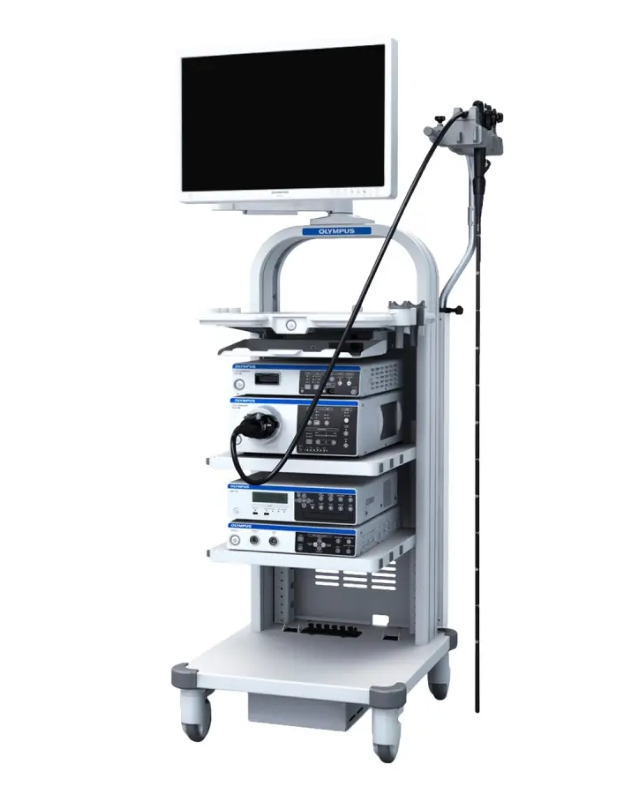
The Olympus CV-190 Plus / CLV-190 endoscopy system is an enhanced Exera III platform delivering advanced imaging performance and extended scope compatibility.
The EVIS EXERA III system represents the third generation of Olympus's diagnostic and therapeutic endoscopy line. It pairs an advanced HDTV video processor, the CV-190, with a dedicated xenon light source, the CLV-190, to deliver high-quality diagnostic imaging, enhanced vascular contrast, and access to a wide range of cutting-edge endoscope technologies. Olympus positions this system as a way to revolutionize clinical workflow while also extending the value of an existing endoscope inventory.
According to the brochure, NBI on the EVIS EXERA III 190 series provides twice the viewable distance compared to the previous EVIS EXERA II 180 series, thanks to an improved lamp design and more powerful signal processing. This translates into markedly better contrast between blood vessels and mucosa, making it easier to detect subtle lesions during examination.
The dual focus function, available with compatible HQ scopes, allows switching between a near-focus view and a normal-focus view, giving an optimal view depending on the nature of the observation. The CV-190 processor's improved image processing also delivers more faithful color reproduction, minimized image noise, and reduced halation.
The CV-190 system supports portable memory for standard data management (via MAJ-1925 media), as well as connection to peripheral equipment such as a monitor, video recorder, video printer, or image filing system. The Olympus documentation system enhances networking capability, and DV output supports compatibility with suitable documentation devices. Up to 50 patient data sets can be pre-registered, streamlining exam preparation.
The CLV-190's waterproof one-touch connector simplifies scope setup and reduces handling when switching scopes. The noise reduction achieved through the redesigned fan contributes to a more comfortable room environment for the care team. User settings, except for the filter setting, are retained in memory even when the light source is switched off, simplifying the transition between examinations.
The EVIS EXERA III system represents the third generation of Olympus's diagnostic and therapeutic endoscopy line. It pairs an advanced HDTV video processor, the CV-190, with a dedicated xenon light source, the CLV-190, to deliver high-quality diagnostic imaging, enhanced vascular contrast, and access to a wide range of cutting-edge endoscope technologies. Olympus positions this system as a way to revolutionize clinical workflow while also extending the value of an existing endoscope inventory.
According to the brochure, NBI on the EVIS EXERA III 190 series provides twice the viewable distance compared to the previous EVIS EXERA II 180 series, thanks to an improved lamp design and more powerful signal processing. This translates into markedly better contrast between blood vessels and mucosa, making it easier to detect subtle lesions during examination.
The dual focus function, available with compatible HQ scopes, allows switching between a near-focus view and a normal-focus view, giving an optimal view depending on the nature of the observation. The CV-190 processor's improved image processing also delivers more faithful color reproduction, minimized image noise, and reduced halation.
The CV-190 system supports portable memory for standard data management (via MAJ-1925 media), as well as connection to peripheral equipment such as a monitor, video recorder, video printer, or image filing system. The Olympus documentation system enhances networking capability, and DV output supports compatibility with suitable documentation devices. Up to 50 patient data sets can be pre-registered, streamlining exam preparation.
The CLV-190's waterproof one-touch connector simplifies scope setup and reduces handling when switching scopes. The noise reduction achieved through the redesigned fan contributes to a more comfortable room environment for the care team. User settings, except for the filter setting, are retained in memory even when the light source is switched off, simplifying the transition between examinations.
Portable memory (named accessory):
 Francais