Phone: (+33) 625 16 20 71 - Sunday to Friday
contact@alliancemedicalfrance.fr
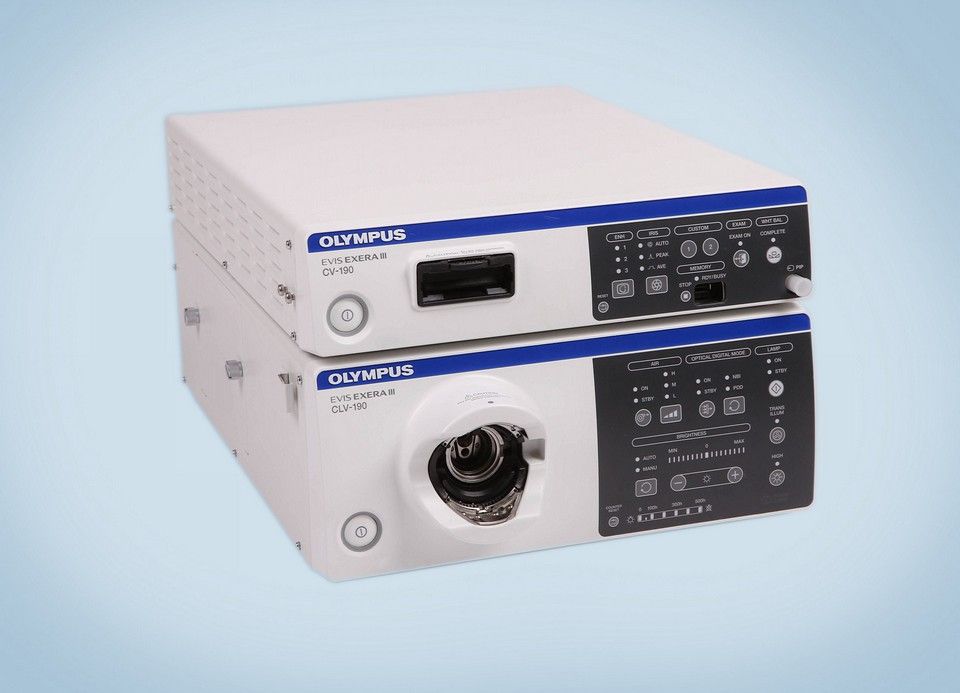
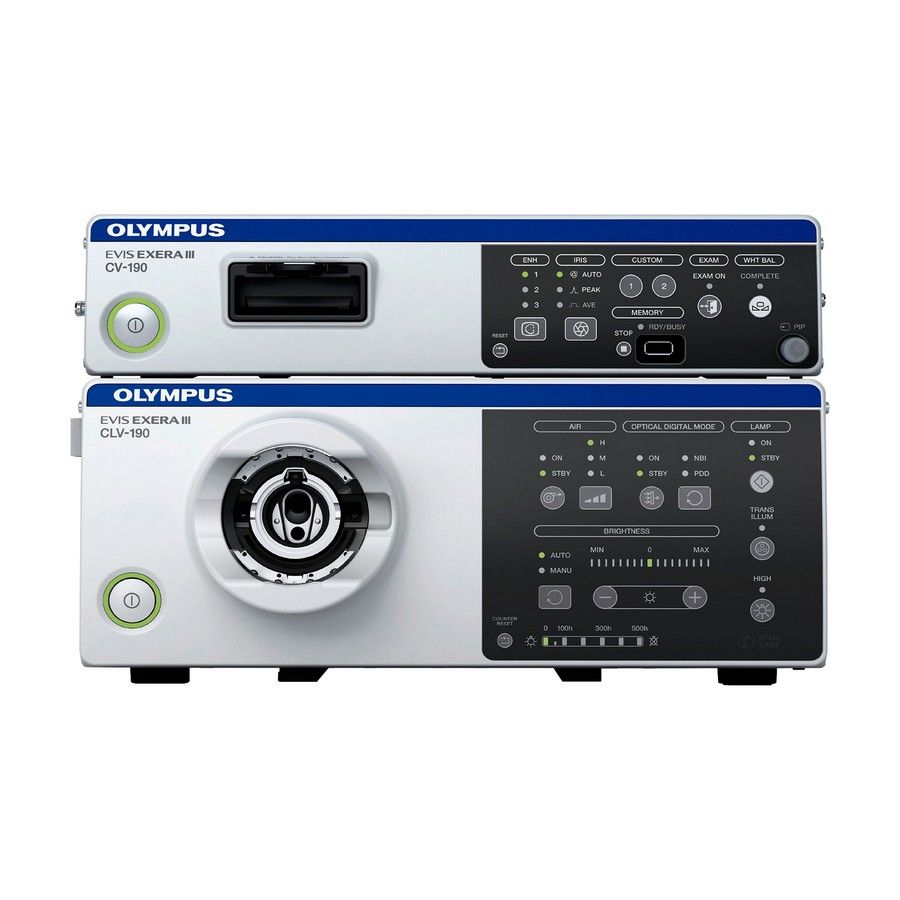

Olympus CLV-190 EVIS EXERA III xenon light source with one-touch access to HDTV and NBI. 300W lamp, waterproof one-touch scope connector, quieter fan, automatic brightness control, and fast link connection to peripheral devices.
The CLV-190 is a xenon light source from the Olympus EVIS EXERA III series, offering one-touch access to HDTV and Narrow Band Imaging (NBI).
The CLV-190 uses a 300 W ozone-free xenon short-arc lamp with an average life of approximately 500 hours of continuous use, ignited via a switching regulator. Brightness is controlled by a light-path diaphragm, with normal and high intensity modes and forced-air cooling. NBI observation is available, and color conversion can be done with a special-purpose filter. A 12 V, 35 W halogen emergency lamp (average life approximately 500 hours) is built into the mirror as backup illumination.
A servo-diaphragm method adjusts brightness automatically across 17 steps of automatic exposure.
A diaphragm-type pump supplies air at four pressure levels (off, low, medium, high). Water is fed by pressurizing a detachable water container with air.
Front panel indicators show the status of the emergency lamp (absence, disconnection, or use) and light up when NBI observation is enabled. Settings are stored even when the light source is switched off, except for the filter setting.
The CLV-190 is a xenon light source from the Olympus EVIS EXERA III series, offering one-touch access to HDTV and Narrow Band Imaging (NBI).
The CLV-190 uses a 300 W ozone-free xenon short-arc lamp with an average life of approximately 500 hours of continuous use, ignited via a switching regulator. Brightness is controlled by a light-path diaphragm, with normal and high intensity modes and forced-air cooling. NBI observation is available, and color conversion can be done with a special-purpose filter. A 12 V, 35 W halogen emergency lamp (average life approximately 500 hours) is built into the mirror as backup illumination.
A servo-diaphragm method adjusts brightness automatically across 17 steps of automatic exposure.
A diaphragm-type pump supplies air at four pressure levels (off, low, medium, high). Water is fed by pressurizing a detachable water container with air.
Front panel indicators show the status of the emergency lamp (absence, disconnection, or use) and light up when NBI observation is enabled. Settings are stored even when the light source is switched off, except for the filter setting.
 Francais